
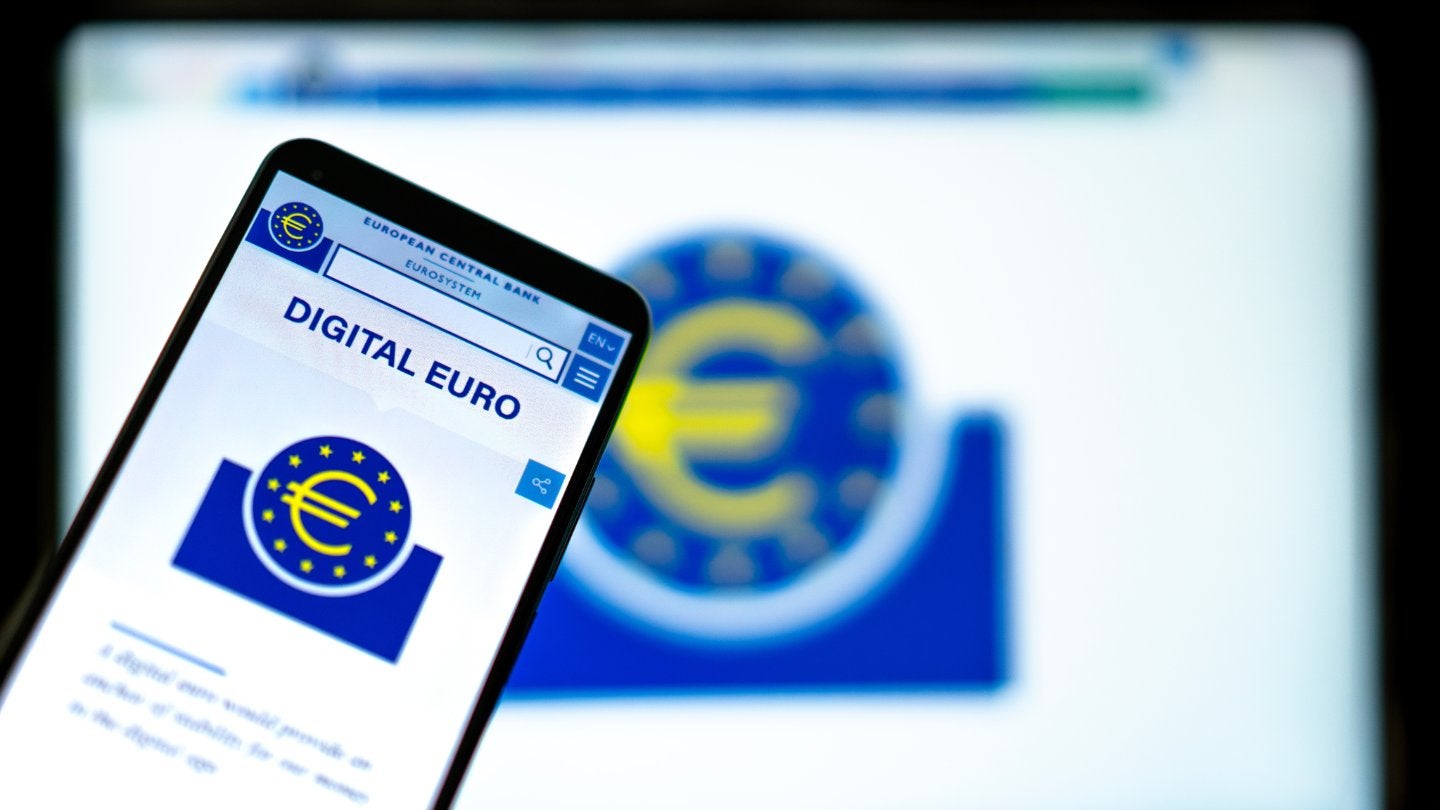
The European Central Bank (ECB) has chosen 36 payment service providers (PSPs) to participate in a digital euro pilot.
The exercise brings together PSPs from across the euro area to test the digital euro’s “technical functionality and operational processes”, according to a central bank statement. The pilot is also intended to help refine the user experience, it added.

Access deeper industry intelligence
Experience unmatched clarity with a single platform that combines unique data, AI, and human expertise.
Eurosystem, the monetary authority of the eurozone, opened a call for expressions of interest in March and received more than 50 applications.
The selected participants include banks and non-bank providers, including Deutsche Bank, UniCredit, Revolut, Nexi Payments, Worldline Financial Services (Europe), Raiffeisen Bank International and Poste Italiane.
The pilot is scheduled to start in the second half of 2027 and run for 12 months.
ECB executive board member Piero Cipollone said: “The strong market interest in the pilot shows the private sector’s readiness to engage actively and quickly advance with the digital euro project to strengthen the European payments landscape.
“We look forward to deeper engagement as we work with and learn alongside European payment service providers in developing a secure, efficient and inclusive digital euro.”
The pilot will use a beta version of the digital euro. The system will be technically and functionally “close to the digital euro” outlined in draft legislation, ECB said. However, the beta system will not have legal tender status.
Some participating firms will act as “distributing PSPs” and provide Eurosystem staff with access to beta digital euro services. This includes opening a beta digital euro account and making payments.
Other participants will act as “acquiring PSPs” and enable selected merchants to accept beta digital euro payments. Some firms will take on both roles.
The pilot will take place at the ECB and 19 Eurosystem national central banks in Belgium, Germany, Estonia, Ireland, Greece, Spain, France, Croatia, Italy, Cyprus, Latvia, Lithuania, Luxembourg, the Netherlands, Austria, Portugal, Slovenia, Slovakia and Finland.
Selected PSPs will be able to provide pilot services in countries other than where they are established.
Participants will include staff from the ECB and national central banks, as well as e-commerce merchants and merchants offering everyday services on their premises, including cafeterias and restaurants.
According to ECB, the selected PSPs will now work with their national central banks and the ECB to complete preparations for the pilot.