
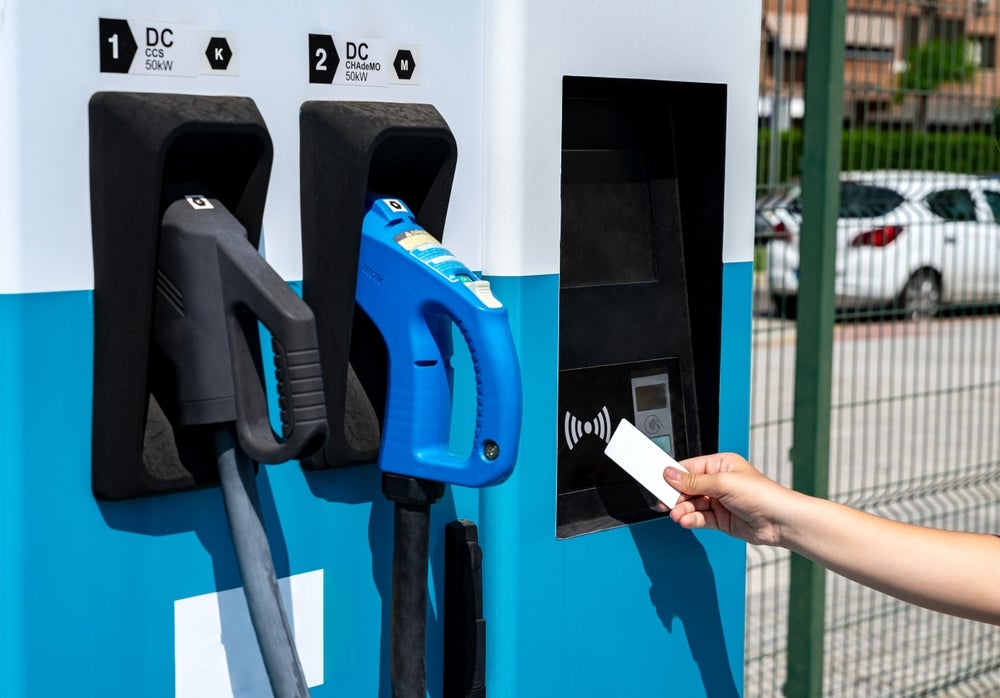
Europe’s transition to electric vehicles (EVs) is one of the most significant infrastructure shifts of the past generation. Governments are investing in charging networks, manufacturers are accelerating production and grid operators are planning for levels of demand that barely existed a decade ago.
Most of the conversation focuses on energy: how much is needed, how quickly it can be delivered and whether charging networks can keep pace with adoption. However, there is another conversation that deserves far more attention: Europe’s EV transition is a payments challenge.
The moment that matters
A driver pulls up to a public charging point, they plug in, then comes the moment that determines whether the experience feels seamless or frustrating: payment.
Go deeper with GlobalData


Access deeper industry intelligence
Experience unmatched clarity with a single platform that combines unique data, AI, and human expertise.
Across Europe, that moment still involves unnecessary friction far too often. Drivers are asked to download proprietary apps before they can charge. They encounter RFID cards tied to specific networks. They struggle with unclear pricing structures or limited payment options. In the modern day where consumers expect to tap a card or digital wallet and move on, the charging experience frequently falls short of that expectation. And this is not a minor inconvenience.
For EVs to achieve mainstream adoption, charging needs to feel as straightforward as refuelling. The charging networks are being built but the payment layer is struggling to keep pace.
Regulation is revealing the gap
The Alternative Fuels Infrastructure Regulation (AFIR), which came into force across the EU in 2023 and entered its enforcement phase in 2026, requires all new public charging stations above 50kW to accept open card payments. Existing stations have until 1 January 2027 to retrofit.
At the same time, the European Accessibility Act introduces additional requirements for self-service payment environments, while PCI DSS 4.0 places greater emphasis on payment security across unattended environments.
Three major regulatory frameworks are converging on EV charging infrastructure at the same time. But regulation is not the story. It is the trigger that is exposing a much bigger truth: payment infrastructure has become critical infrastructure. Not only for retail and hospitality, but increasingly for mobility, energy and everyday urban life.
Operators who treat AFIR as a compliance exercise may meet the immediate deadline, but they risk facing the same challenges again in a few years’ time. Those who use this moment to rethink their payment architecture will be in a far stronger position.
The infrastructure challenge goes beyond compliance
What makes EV charging unique is the environment in which it operates. Unlike a retail checkout or restaurant terminal, a charging point may be located in a motorway service station, a supermarket car park, a residential street or a remote roadside location. It operates unattended, often around the clock, in all weather conditions. It must accept a wide range of payment methods securely and reliably, without staff intervention and without the fallback options available in attended environments.
That requires a specific approach to payments. Operators need technology that supports open standards, accommodates changing requirements and can evolve without costly hardware replacement programmes. They need systems capable of handling accessibility requirements, security updates and new payment methods throughout the lifespan of the installation.
Payments companies have spent years solving these challenges in unattended retail, vending and transport environments. EV charging is now facing many of the same questions. Therefore, interoperability is a commercial necessity.
Connected mobility is changing expectations
The conversation becomes even more interesting when we look beyond today’s charging experience. As EV adoption increases and vehicles become more connected, payment experiences will become increasingly integrated into wider mobility ecosystems. In-car payment capabilities, vehicle-initiated transactions and connected mobility accounts are already emerging across multiple markets.
The charging transaction itself may eventually become almost invisible. Authentication, payment and settlement could happen automatically in the background, integrated into a broader mobility experience rather than treated as a standalone transaction. That future depends entirely on the decisions being made today. Open standards, interoperable infrastructure and flexible software architectures will allow charging networks to evolve alongside consumer expectations. Closed systems designed around a single network or use case will struggle to deliver that flexibility.
Payments are becoming part of urban infrastructure
There is a broader lesson here. Across Europe, transport, parking, EV charging and public services are becoming increasingly connected. The vision of the smart city is being built today through thousands of individual infrastructure projects. For that vision to work, payments must be seamless.
A resident should be able to use the same payment credentials to access transport, parking, EV charging and other services without friction or complexity. That level of convenience depends on infrastructure that is open, interoperable and designed to support multiple services rather than isolated networks.
The payment layer is becoming an essential component of how cities function. EV charging is where this challenge is currently most visible. It sits at the intersection of mobility, energy, regulation and consumer expectations. The way the industry responds over the next 18 months will provide a useful indication of how prepared Europe is for the next phase of connected urban infrastructure.
The transition is also a payments transition
Europe’s EV transition is often discussed as an energy challenge. Increasingly, it is also a payments challenge. Getting the payment experience right is not a secondary consideration – it influences trust, adoption and the overall user experience. It determines whether charging feels intuitive or unnecessarily complicated. The energy is being delivered but the question now is whether the payment layer will keep pace.
Jean-Philippe Niedergang, Acting Group CEO / EMEA-PACIFIC-LATAM CEO, Castles Technology